
Jeffrey Epstein in Africa: The Powerful Leaders Who Crossed His Path
- Yasin Kakande

- Mar 10
- 5 min read
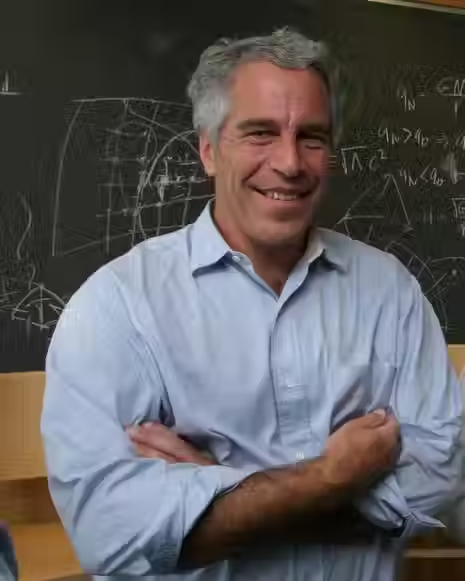
Jeffrey Epstein, the American financier and convicted sex offender, left a strange footprint in Africa.
He did not fly around the continent shaking hands like a diplomat. Epstein preferred shadows. Quiet hotel rooms. Private dinners. Emails sent late at night. He was the kind of man who opened doors for powerful people and then slipped quietly into the room behind
them.
Most of the time he was not acting like a banker. He was acting like a fixer. A broker of influence. The man who knew another man who knew another man.
And wherever the rich and powerful gathered — New York, London, Paris, or somewhere in Africa — Jeffrey Epstein always seemed to pull up a chair at the table.
Here are ten African leaders and political figures whose names appear in documents, emails, or reports linked to his network.
Nina Keita — niece of Ivory Coast’s president
Keita, a former model and niece of Ivory Coast’s president Alassane Ouattara, exchanged hundreds of messages with Epstein between 2011 and 2018. The emails read less like diplomacy and more like the planning of a strange social club.
In one exchange in 2011, Keita asked Epstein if he wanted to meet one of her friends in
Paris. She described the woman as twenty-five years old, easygoing, not complicated, nice. Epstein asked for more details.
Soon a meeting was arranged at the Ritz Hotel in Paris on August 31, 2011.
After the meeting, Epstein wrote back saying the woman was exactly as described. Then he added something colder. He said he preferred women under twenty-five. He asked Keita to request pictures of the woman’s younger sister. When that did not happen, Keita later sent a photograph herself.
During another visit in 2012, when Epstein traveled to Abidjan, Keita told him she had reserved the ministerial suite at the Hôtel Ivoire.
Epstein replied that he hoped to see some very pretty girls.
Keita answered that this would be the case.
But Keita was not only arranging social introductions. She also introduced Epstein to her uncle, President Ouattara, in New York in 2011 and helped organize a meeting in Abidjan in 2012 where Epstein discussed investment projects with ministers.
She also helped facilitate a proposed $150 million Israeli surveillance deal for Ivory Coast. The deal did not go through, though later security cooperation followed.
Keita has not been charged with any crimes and has not publicly responded to the
revelations.
Jacob Zuma — former president of South Africa
Before the Epstein files appeared, Jacob Zuma already carried more scandals than a
traveling circus.
His name appears eighty-seven times in the documents. One email chain discusses Epstein arranging a small private dinner for Zuma at the Ritz Hotel in London in March 2010 during a state visit.
Someone even suggested inviting a Russian model to add glamour. Apparently, diplomacy sometimes needs a little decoration.
After the dinner, feedback from Epstein’s circle described Zuma as impressive.
Robert Mugabe — former president of Zimbabwe
If Zimbabwe’s economy was a laboratory experiment, it was the kind where the smoke
alarm never stops ringing.
In a 2015 email, Epstein proposed meeting Robert Mugabe during Zimbabwe’s hyperinflation crisis. He described the country as a great petri dish for financial
experimentation.
That is a strange way to describe a nation where people once needed a suitcase full of cash just to buy bread.
An unverified FBI report later suggested Epstein may have acted as a wealth manager for Mugabe and Russian president Vladimir Putin, though this has never been proven.
Karim Wade — son of Senegal’s president
If Epstein had a favorite political contact in Africa, it may have been Karim Wade, the son of Senegal’s president Abdoulaye Wade.
Wade’s name appears more than five hundred times in the documents.
Starting around 2010, Wade helped organize Epstein’s travel in West Africa. In 2011 he arranged meetings with presidents in Senegal, Mali, and Gabon.
He handled visas, introductions, and logistics — the kind of backstage work that keeps powerful men moving.
Later, when Wade was jailed in Senegal on corruption charges, he reportedly asked Epstein to help hire American lobbyists and lawyers to secure a pardon.
In 2016 he was pardoned and later moved to Qatar.
Abdoulaye Wade — former president of Senegal
During Epstein’s 2011 trip through West Africa, he met Senegal’s president Abdoulaye
Wade.
The introduction was arranged by Wade’s son Karim, who at the time controlled several powerful government ministries.
Epstein was hosted in Senegal and discussed possible investments, particularly in infrastructure projects.
Paul Kagame — president of Rwanda
Rwanda’s president Paul Kagame runs a small but heavily militarized country that plays an outsized role in Central Africa.
Epstein met Kagame at least twice.
The first meeting happened in 2002 during an AIDS-focused trip that also included former U.S. president Bill Clinton.
The second meeting took place in 2007 during a visit to Rwanda marking the anniversary of the genocide.
During one meeting, Epstein asked Kagame to help identify two Rwandan students who could receive funding for university studies in the United States.
But Epstein’s so-called philanthropy has always raised questions. Investigators have long suspected he sometimes used student visas and educational programs to move young women across borders.
Teodoro Nguema Obiang Mangue — vice president of Equatorial Guinea
The son of Equatorial Guinea’s long-time ruler had a friendship with Epstein that stretched over two decades.
The two men traveled together, including trips to Rio de Janeiro’s famous carnival in Brazil.
They also met frequently in Paris and discussed business projects in Equatorial Guinea involving oil and luxury tourism.
Obiang himself has faced several international corruption cases involving massive wealth allegedly taken from public funds.
Uhuru Kenyatta — former president of Kenya
Epstein claimed in documents that he knew Uhuru Kenyatta very well, though details of the relationship remain unclear.
Some documents connected Kenya to wider trafficking networks in East Africa, mentioning coastal towns like Malindi as locations sometimes associated with international sex tourism.
Routes through Mombasa were also mentioned in discussions about trafficking across East Africa.
Ali Bongo — president of Gabon also met Jeffrey Epstein
Epstein met Ali Bongo in Gabon during the 2011 West African tour arranged by Karim Wade.
Their discussions focused mostly on infrastructure projects and high-level networking.
Later in 2013, Wade offered to arrange another meeting between the two men, though it is unclear whether it ever happened.
Alassane Ouattara — president of Ivory Coast
Epstein’s connection to Alassane Ouattara largely ran through Ouattara’s niece, Nina Keita.
Through her, Epstein planned meetings with the president and ministers in Abidjan to
discuss investment projects.
Keita also introduced Epstein to Ouattara’s son Dramane during a meeting in New York.
Through this network, Epstein helped introduce former Israeli prime minister Ehud Barak to figures in Ouattara’s circle. Discussions included a proposed $150 million surveillance system for Ivory Coast.
The deal was rejected because of the cost, though later security cooperation between Israel and Ivory Coast followed.
Goodluck Jonathan — former president of Nigeria
Epstein never had a confirmed direct meeting with Nigeria’s president Goodluck Jonathan.
But he still appeared in the background.
Epstein worked closely with Israeli politician Ehud Barak, helping finance and advise business ventures seeking security contracts in Nigeria during the Boko Haram insurgency.
In 2013 Barak attended a cybersecurity conference in Abuja. Organizers privately described it as a convenient excuse to arrange meetings with Nigeria’s leadership.
Barak’s schedule included a meeting with President Jonathan and a dinner hosted by the first lady attended by senior military and intelligence officials.
That same year Nigeria awarded a $40 million intelligence contract to Israeli company Elbit Systems to install internet surveillance infrastructure.
Israeli technicians later arrived to set up the system while Nigerian personnel were trained abroad.
Epstein remained mostly behind the curtain, advising Barak through emails and helping gather information about Jonathan’s inner circle through a private intelligence firm.
— Yasin Kakande
Author of The Missing Corpse

Comments